
Cape Coral Roof Repair
Roof Repair Cape Coral FL
Roofs in Cape Coral fail at their details first — flashing, penetrations, valleys and fasteners — long before the field of the roof gives out. This site is built around that reality: diagnostic guides for leaks, storm damage and hurricane season, repair pages for shingle, tile, metal and low-slope assemblies, and a structured urgency checker for deciding what needs attention now. Describe what the roof is doing and a repair request goes to the right place.
Roof Repair Cape Coral FL
1222 SE 47th St, Suite 450B, Cape Coral, FL 33904
Active damage
Water Coming In Right Now
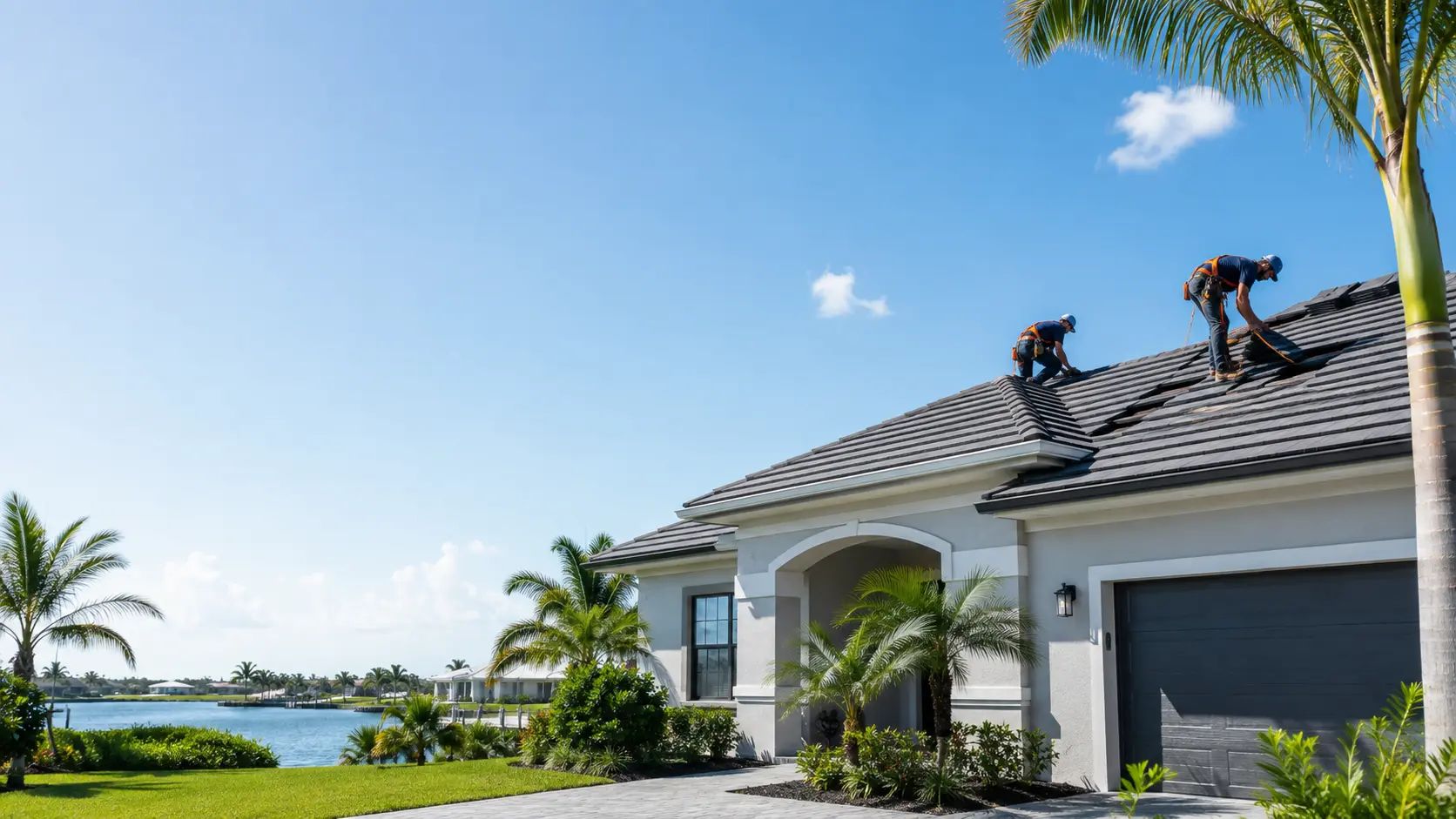
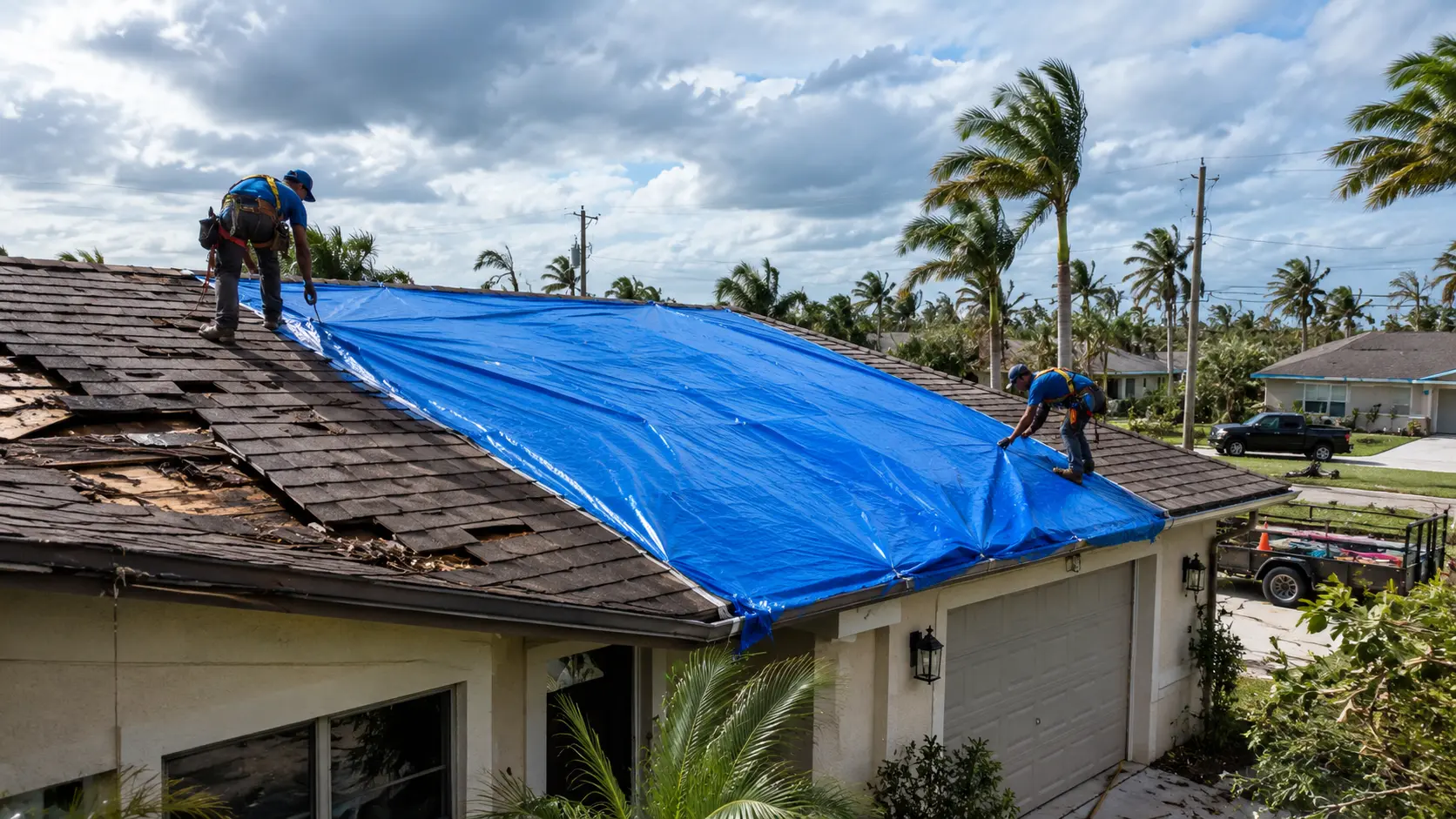
An open roof does not wait for a scheduling window. When material is missing, decking is exposed or water is running inside during rain, the priority is stopping the water path — usually with temporary protection — and then repairing the failure properly once the roof is stable and dry enough to work on.
- Do not climb a storm-damaged roof; decking can be compromised where nothing looks wrong.
- Photograph interior stains, ceiling bulges and any material on the ground before cleanup.
- Contain water and move belongings clear of the affected area.
- Note the time and weather conditions when the leak appeared.
Diagnostics
Common Roof Leak Areas
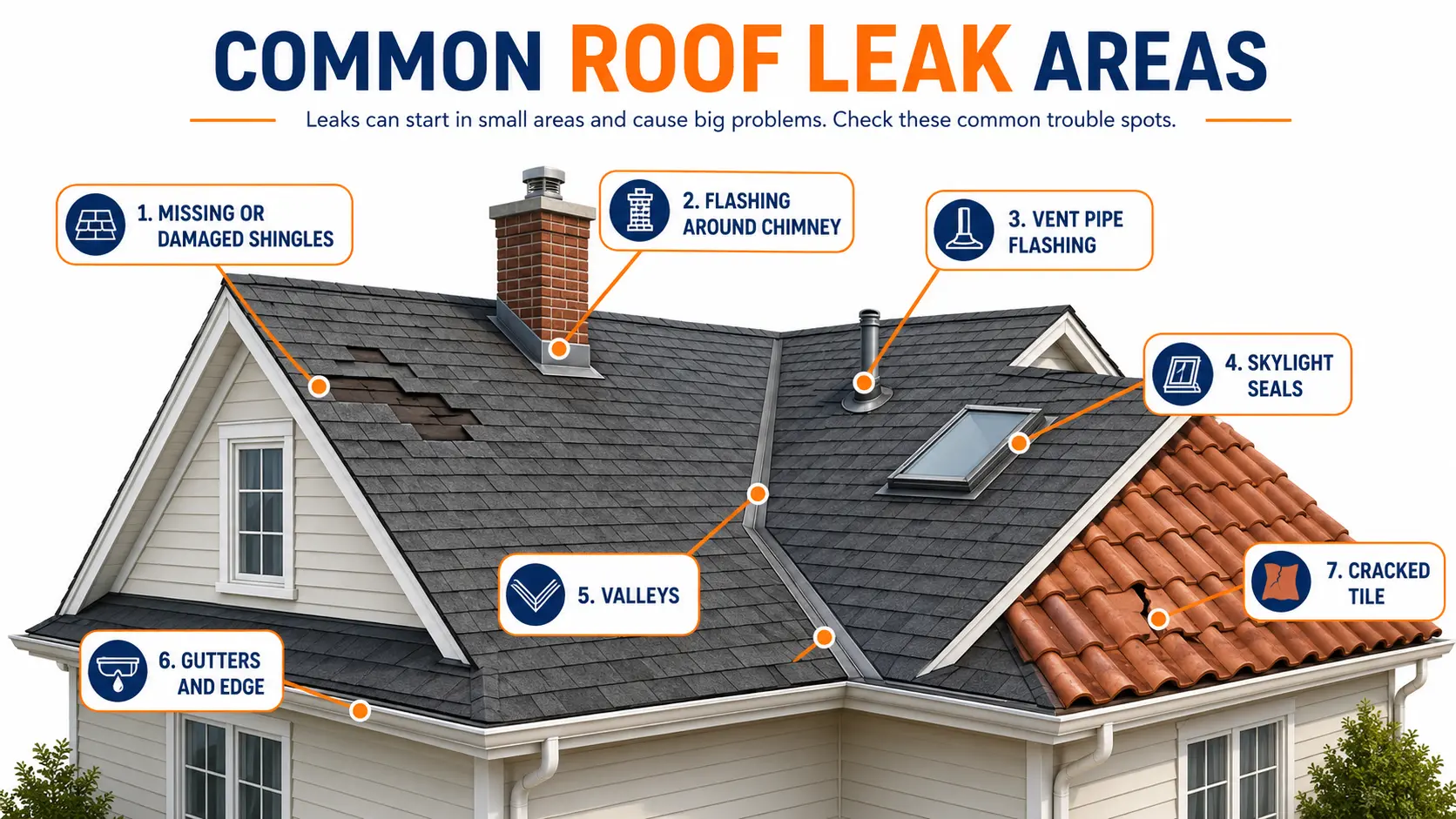
Water rarely enters through the middle of an intact roof plane. It enters where the roof is interrupted: where a pipe passes through, where a wall meets a slope, where two planes converge into a valley, where a skylight curb rises above the surface, or where the roof terminates at an edge. Each of these details relies on a layered arrangement of flashing, underlayment and sealant to redirect water back onto the surface. When one layer moves, corrodes, cracks or is installed out of sequence, the detail stops shedding and starts collecting.
Southwest Florida adds two pressures that make details fail earlier than the surrounding material. Ultraviolet exposure and daily heat cycling break down sealants and cause metal components to expand and contract thousands of times a year, gradually loosening fasteners and opening hairline gaps. Then seasonal storms deliver rain at an angle, driven by wind, so water is pushed sideways and upward beneath laps that shed vertical rain perfectly well. A roof can be watertight through a summer afternoon downpour and leak during a tropical system with less total rainfall.
Water also travels before it appears. It commonly runs along the underside of decking, follows a rafter or truss chord, and drops several feet from the actual entry point. That is why a ceiling stain near an interior wall may originate at a vent boot on the opposite side of the room, and why chasing the stain instead of the path leads to repeat repairs. A methodical inspection works uphill from the interior evidence, checking every penetration and transition above it before concluding anything about the field of the roof.
The diagram highlights the details that account for most leaks: pipe and vent penetrations, chimney and wall flashing, valleys, skylight curbs, ridge and hip lines, and the eave and drip-edge assembly. Reviewing these locations first — from the ground, from inside the attic, and during an inspection — narrows the search dramatically.
Repair services
Roof Repair Services in Cape Coral
- 01Roof Leak RepairLocating the entry point rather than patching the stain: penetrations, flashing, valleys, fasteners and underlayment are traced back from where water appears inside.
- 02Emergency Roof RepairStabilizing an open roof when water is entering now, including temporary protection so interior damage stops spreading before a permanent repair.
- 03Storm Damage Roof RepairAssessment and repair after wind, debris impact and wind-driven rain, including lifted materials that still look seated from the ground.
- 04Hurricane Roof Damage RepairPost-hurricane evaluation covering uplift at edges and ridges, displaced tile, torn underlayment and water paths created during the storm.
- 05Roof TarpingTemporary covering for exposed decking or underlayment, secured to shed water until conditions and scheduling allow permanent work.
- 06Roof Flashing RepairRepair of the metal transitions at walls, chimneys, valleys and curbs, where a large share of leaks in Southwest Florida originate.
- 07Roof Vent RepairCorrecting damaged, corroded or poorly sealed vent housings, boots and turbines that let water pass through the roof plane.
- 08Skylight Leak RepairDiagnosis of skylight leaks, which may be curb flashing, perimeter sealant, glazing seals or condensation rather than the unit itself.
- 09Soffit & Fascia RepairRepair of the roof edge assembly where wind-driven rain, corrosion and water back-up commonly cause visible damage first.
- 10Roof InspectionA structured review of materials, details and interior evidence, producing a clear picture of what is failing and what is still sound.
Local conditions
Why Cape Coral Roofs Develop Problems
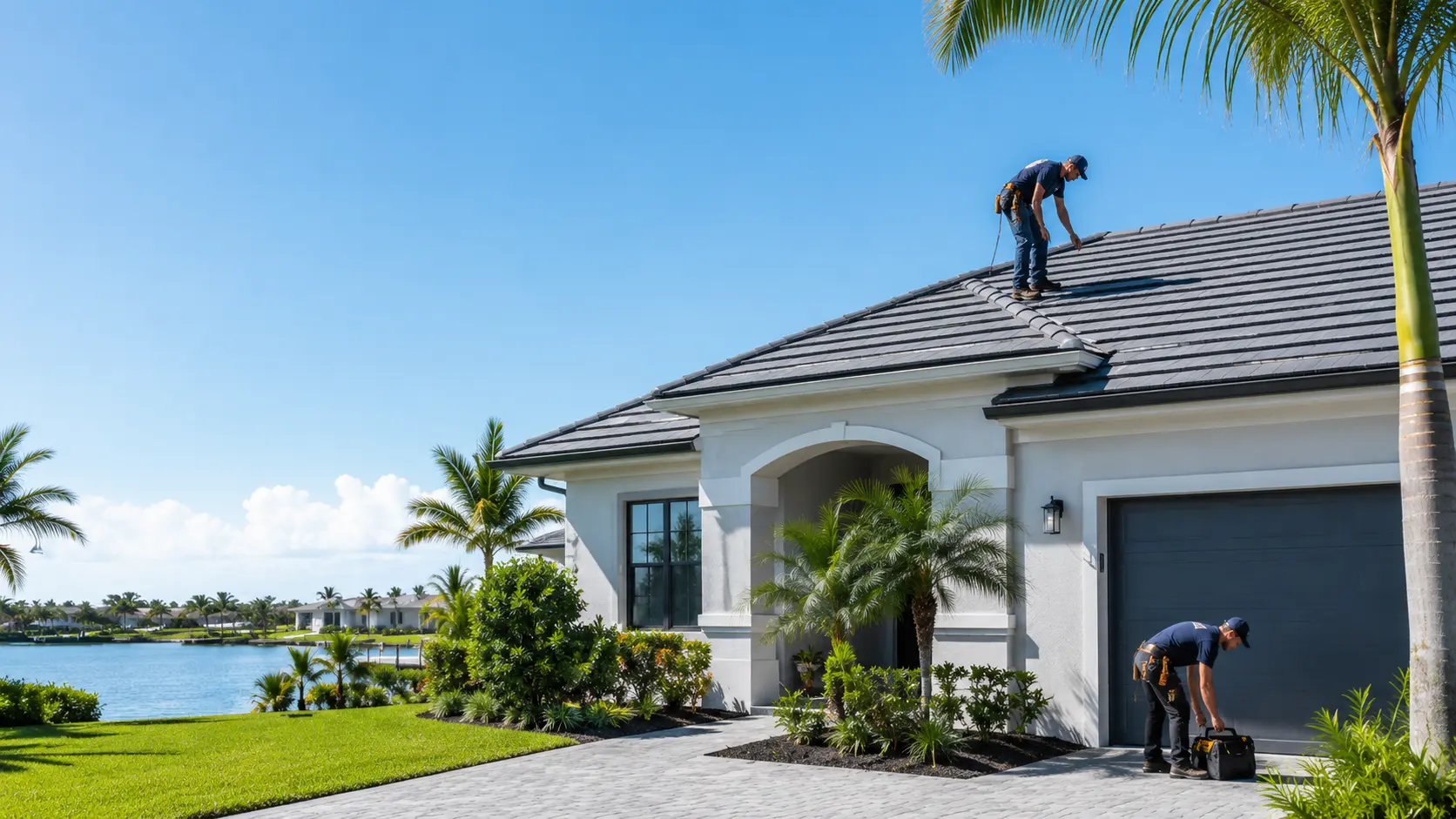
Cape Coral sits on a low peninsula between the Caloosahatchee River and the Gulf, cut through by one of the largest canal networks in the world. That geography sets the conditions every roof in the city has to withstand: intense year-round sunlight, high humidity, a pronounced wet season, tropical systems, and salt-laden air that reaches well inland on a sea breeze. None of these are unusual individually. In combination, and sustained across a decade, they age roofing assemblies faster than the same materials would age in a temperate climate.
Ultraviolet exposure is the constant. Asphalt shingles lose volatile oils and shed granules, which gradually exposes the mat beneath. Sealant beads at flashing and penetrations become brittle and pull away from the substrate. Rubber pipe boots, one of the most common leak sources on any roof, crack at the collar after years of direct sun. On tile roofs the tile itself resists UV well, but the underlayment beneath it experiences elevated attic-adjacent temperatures and ages on its own schedule — which is why a tile roof can look sound from the street while its waterproofing layer is at the end of its service life.
Thermal cycling compounds that. Roof surfaces here can swing dramatically between a mid-afternoon peak and a pre-dawn low, and every cycle expands and contracts metal flashing, drip edge, panel seams and fasteners. Over thousands of cycles, fasteners back out fractionally, gaskets compress permanently, and laps that were tight on installation day develop capillary gaps. Metal roofs, which handle wind exceptionally well, are particularly sensitive to this pattern at exposed-fastener locations.
The wet season delivers water in volume and at an angle. Afternoon convective storms drop heavy rainfall in short bursts, testing drainage, valleys, gutters and low-slope drains all at once. Tropical systems add sustained wind that drives rain horizontally into laps, under edges, behind fascia and through soffit venting. Wind pressure also lifts materials at the perimeter and ridge — the zones where uplift forces concentrate — and a shingle or tile that lifts and reseats may leave a compromised seal behind with no visible evidence from the ground.
Salt air is the quieter factor. Proximity to open water and canals accelerates corrosion of exposed metal: fasteners, drip edge, vent housings, flashing, and cut edges on metal panels. Corrosion in these small components is disproportionately important, because they are precisely the parts holding the waterproofing details together. Roofs on canal-front and near-river properties often show this wear earlier than comparable inland roofs of the same age.
Humidity and attic conditions matter too. Ventilation that is blocked, undersized or disrupted by a damaged soffit allows moist air to sit against the underside of the deck. That can produce interior staining that resembles a leak but originates as condensation, and it shortens the life of decking and underlayment even where the exterior surface is intact.
Housing stock adds one more variable. The city grew in distinct waves, so neighborhoods differ in dominant roof type, typical roof age and construction detailing. A newer tile roof in a master-planned community, a 1980s shingle roof in an established central area, and a low-slope addition over a lanai all fail in different ways and on different timelines — which is why diagnosis has to start with the assembly in front of you rather than a general rule about Florida roofs.
Contributing factors
- Year-round ultraviolet exposure
- Daily thermal expansion and contraction
- Wet-season downpours and wind-driven rain
- Tropical system uplift at edges and ridges
- Salt-air corrosion of exposed metal
- Attic humidity and ventilation restrictions
Method
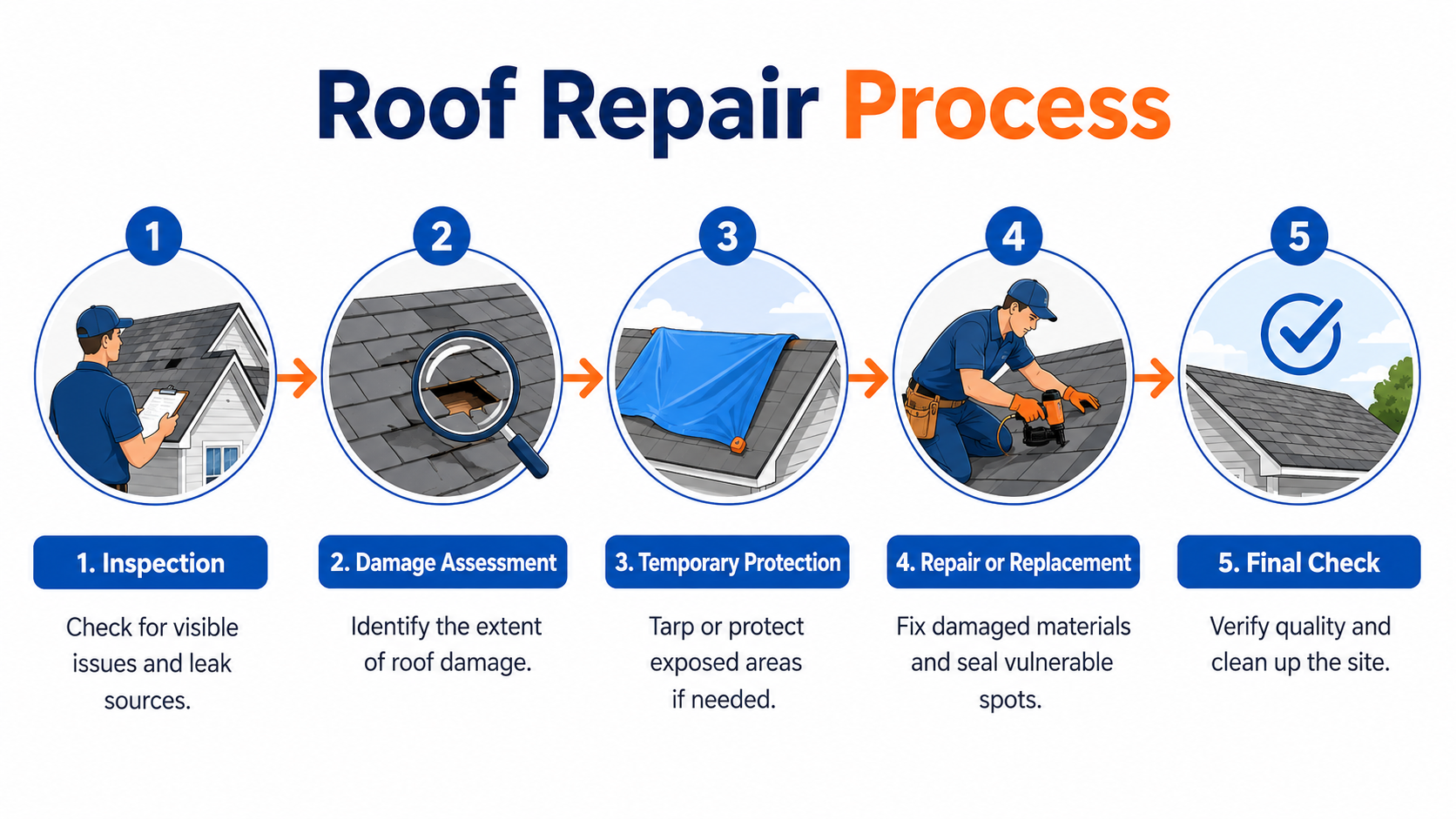
The Roof Repair Process
- 01
Inspection
Review of the roof surface, details, penetrations and interior evidence to establish what is actually failing rather than where the stain appears.
- 02
Damage assessment
Determining the extent: whether the issue is confined to a detail, whether underlayment or decking is involved, and whether repair or replacement is the sound decision.
- 03
Temporary protection
Where a roof is open, covering the affected area so the next rain does not extend the damage while permanent work is arranged.
- 04
Repair or replacement
Correcting the failure with materials matched to the assembly — resetting flashing, replacing underlayment sections, re-securing or replacing tile, shingles or panels.
- 05
Final check
Verifying the repaired detail sheds water correctly, fasteners and sealants are complete, and the surrounding area shows no remaining evidence of intrusion.
Interactive
Roof Repair Urgency Checker
Six questions about what the roof is doing, scored into one of four general categories. Nothing is submitted and no contact details are required.
By assembly
Repair by Roof Type
Asphalt Shingle
Common on inland Cape Coral homes. Typical repairs involve wind-lifted or missing shingles, exposed or backed-out fasteners, sealant strip failure and worn pipe boots. Granule loss on south and west planes is a useful indicator of remaining service life.
Asphalt Shingle repairConcrete & Clay Tile
Widespread across the city. Because the underlayment does the waterproofing, repair usually means lifting tile to reach the layer below, replacing failed underlayment sections and re-securing or replacing broken pieces with matched profiles.
Concrete & Clay Tile repairMetal
Standing seam and exposed-fastener panels behave differently. Repairs commonly address fastener gaskets, panel movement, sealant at penetrations and corrosion at cut edges, which advances faster in salt air near the canals.
Metal repairFlat & Low-Slope
Found over additions, lanais and some flat-roof designs. Ponding, seam separation, membrane punctures and failed drain or scupper details are the usual sources of water entry on these assemblies.
Flat & Low-Slope repairCoverage
Cape Coral Service Areas
Knowledge hub
Roofing Guides for Cape Coral Homeowners
How this site works
Diagnosis First, Then Repair
Written for diagnosis
Every page explains how a failure happens and where to look for it, so a homeowner can describe the problem accurately before anyone is on site.
No inflated claims
There are no testimonials, star ratings or invented credentials on this site. Repair decisions should rest on what an inspection finds at the property.
Cape Coral specific
Guidance is written around local conditions — canal-side salt air, wet-season downpours, tropical system uplift and the roof types common across the city.
Questions
Roof Repair FAQs
- What is the most common cause of a roof leak in Cape Coral?
- Most leaks begin at a detail rather than in the open field of the roof: flashing around walls and chimneys, pipe boots, vents, skylight perimeters and valleys. Wind-driven rain during Southwest Florida storms can also push water under materials that shed water fine in vertical rain.
- Can a roof be repaired instead of replaced?
- Often, yes. Isolated damage, a failed penetration seal, a small section of displaced tile or a corroded fastener line can usually be repaired. Widespread underlayment failure, saturated decking over large areas or damage across most of the roof plane tends to move the decision toward replacement.
- How quickly should storm damage be addressed?
- Missing material or exposed underlayment should be evaluated promptly, because the next rain can carry water into insulation and drywall. Temporary protection such as tarping is often used to stabilize a roof before permanent repairs are scheduled.
- Do tile roofs leak even when the tiles look fine?
- Yes. On a tile roof the underlayment is the waterproofing layer and the tile is the protective covering. Underlayment can degrade from heat and age while the tile above it still looks intact, which is why tile leaks are frequently traced to the layer underneath.
- What does a roof inspection look at?
- A typical inspection reviews roofing material condition, flashing and penetrations, valleys, ridge and hip details, fasteners, sealants, soffit and fascia, ventilation components and any visible interior staining that suggests where water is entering.
- Is it safe to go on a roof after a storm?
- Climbing a storm-damaged roof is not advised. Decking can be weakened where it is not visible, surfaces stay slick, and downed lines may be nearby. Ground-level observation and interior checks are the safer way to document what happened.
- How much does roof repair cost?
- Cost depends on roof type, the size and location of the damaged area, whether decking or underlayment is involved, access and complexity. Published numbers are rarely meaningful without an on-site inspection, so the cost guide on this site explains the drivers rather than quoting prices.
- Does salt air affect roofs near the canals?
- Salt-laden air accelerates corrosion of exposed metal components such as fasteners, drip edge, flashing and vent housings. Roofs near open water often show fastener and flashing wear earlier than comparable roofs further inland.
- What should be done first when a ceiling starts dripping?
- Keep people and belongings clear of a bulging or saturated ceiling, contain the water where it is safe to do so, and photograph the stain and its spread. If water is near lights, outlets or other electrical components, avoid the area and seek appropriate professional assistance. Then have the roof evaluated to locate the entry point, which is often uphill of the interior stain.
- Which roof areas fail first in Southwest Florida?
- Sun-exposed south and west planes, penetrations, and any transition where two surfaces meet. Ultraviolet exposure, daily thermal movement, seasonal downpours and tropical system winds all concentrate stress at these locations.
Start here
Request Roof Repair in Cape Coral
Describe what the roof is doing, when it started and what the property looks like from the ground. The more specific the description, the faster the problem can be narrowed down.
Roof Repair Cape Coral FL
1222 SE 47th St, Suite 450B, Cape Coral, FL 33904