
Understanding Leaks
How Roof Leaks Start and Where to Look
Roof leaks rarely appear directly above where water actually enters the roof system. This guide explains the most common leak sources, how water travels once it gets past the roof surface, and what a roof inspection may examine to find the true origin.
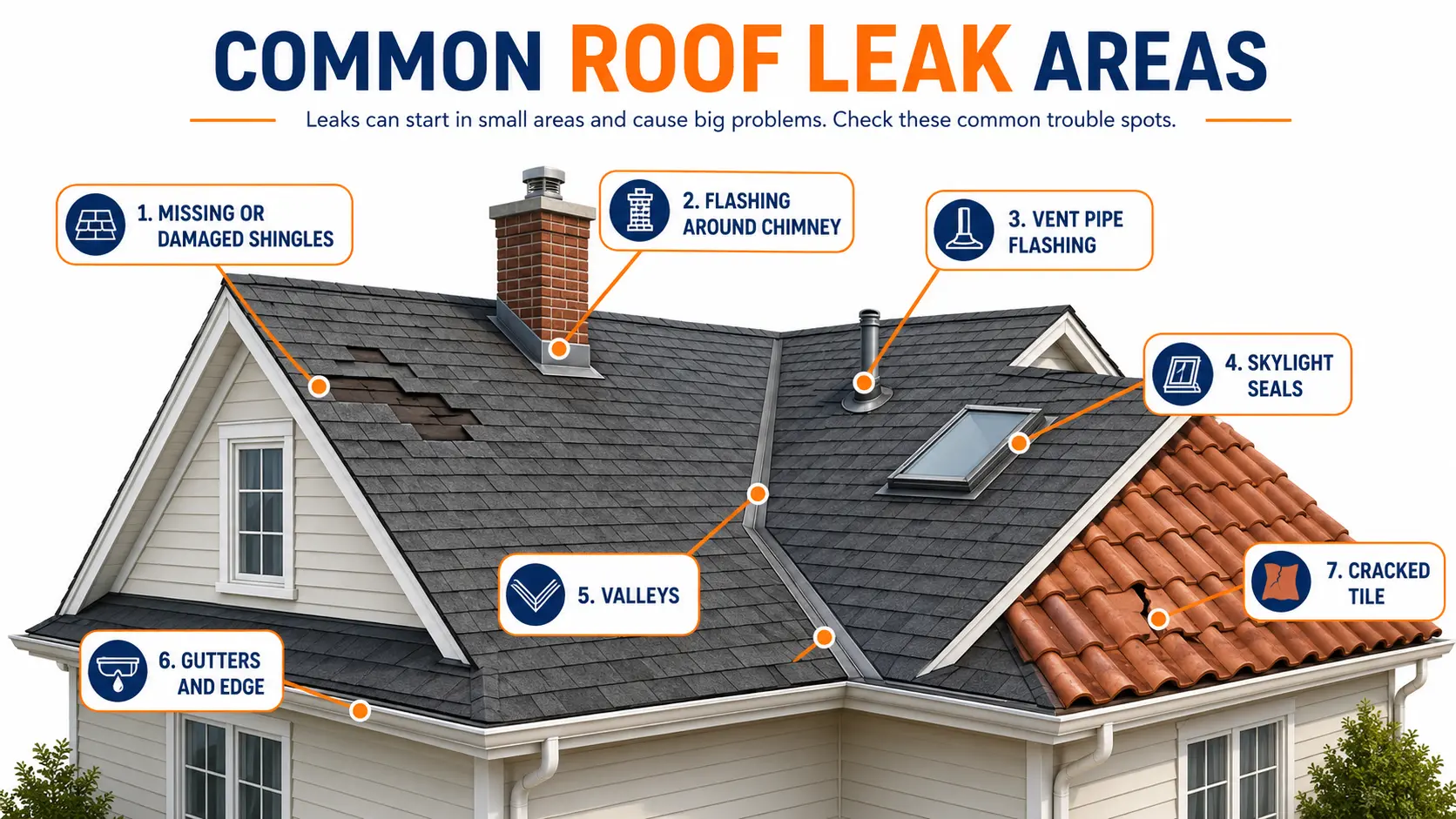
Roof penetrations
Any place where something passes through the roof surface — plumbing vent pipes, exhaust vents, satellite mounts, or HVAC lines — creates a seam that has to be sealed against water. These seals, often rubber boots or metal collars, can crack, shrink, or separate from the surrounding roofing material over time, creating a path for water to enter even when the surrounding shingles or tiles look fine.
Flashing
Flashing is the metal (or sometimes rubberized) material installed at transitions and joints on a roof — around chimneys, along roof-to-wall connections, at dormers, and along roof edges. Flashing works by directing water over and away from these vulnerable joints rather than sealing them shut, so if flashing becomes bent, lifted, corroded, or improperly overlapped, water can be redirected underneath the roofing material instead of off of it.
Valleys
A roof valley is where two roof slopes meet and funnel water down toward the gutters. Because valleys concentrate a much higher volume of water than a flat section of roof, any deterioration in valley flashing or roofing material in this area tends to cause leaks more quickly than similar damage elsewhere on the roof.
Fasteners and underlayment
Nails and screws used to secure shingles, tiles, or metal panels can back out over time due to thermal expansion and contraction, wind uplift, or improper original installation, leaving small openings. Beneath the visible roofing material, an underlayment layer is meant to act as a secondary water barrier. If the underlayment is torn, aged, or was damaged during a previous repair, it may not stop water even if the surface layer is doing its job in most areas.
Wind-driven rain
During storms with strong sustained winds, rain can be pushed at an angle underneath roofing materials, into vents, or around flashing that would otherwise shed water effectively in calmer conditions. This is one reason leaks sometimes appear only during specific storm events rather than during regular rainfall.
Material-specific leak points
Different roofing materials have their own common leak sources worth understanding.
- Asphalt shingle roofs: cracked or missing shingles, exposed or lifted nail heads, worn pipe boots
- Tile roofs: cracked or slipped tiles, deteriorated underlayment beneath otherwise intact tiles, damaged mortar or foam adhesion at ridges
- Metal roofs: failed sealant at panel seams and fasteners, corrosion at cut edges, improperly lapped panels
How water travels once inside the roof
One of the more counterintuitive aspects of roof leaks is that the point where water enters is often not directly above where a stain or drip appears indoors. Water can travel horizontally along the underlayment, decking, or framing members before finding a gap or lower point to drip through, sometimes traveling several feet from the original entry point. This is why a ceiling stain in one room doesn't always correspond to obvious damage on the roof surface directly overhead.
What a roof inspection typically examines
Tracing a leak to its source generally involves examining more than just the spot where a stain appeared. An inspection may include checking flashing and penetrations near and upslope from the interior damage, examining the attic for water trails along framing and decking, and assessing the general condition of the roofing material and underlayment in the surrounding area.
Temporary steps if you notice an active leak indoors
If you notice water entering your home during a storm, some basic steps can help limit interior damage while you arrange for an inspection.
- Place a container to catch dripping water and move furniture or belongings out of the way
- If a ceiling is visibly bulging with trapped water, it may help to relieve it in a controlled way into a container, since a small controlled release is often less damaging than a larger uncontrolled collapse
- Take photos of the active leak and any resulting damage for your records
- Avoid attempting to access the roof yourself during or shortly after a storm
Questions & Answers
- Why doesn't my ceiling stain line up with visible roof damage?
- Water often travels along the underlayment or framing before dripping through, so the entry point can be several feet from where the stain appears.
- Are roof valleys more prone to leaks?
- Valleys carry a larger volume of water than flat roof sections, so any wear or damage there tends to cause leaks sooner than similar wear elsewhere.